Renishaw Probe Programming Examples . By specifying a k value, that would determine the probing axis. Open the probe bore template. Renishaw RVP REVO NonContact Video Probe Metrology and Quality News from metrology.news I’ve never used a probe before until now. If you've just replaced your spindle probe or spindle probe stylus, it's important to calibrate the probing system before using it. Description the renishaw gui is a user interface for use with renishaw’s inspection plus, easyset and tool setting software.
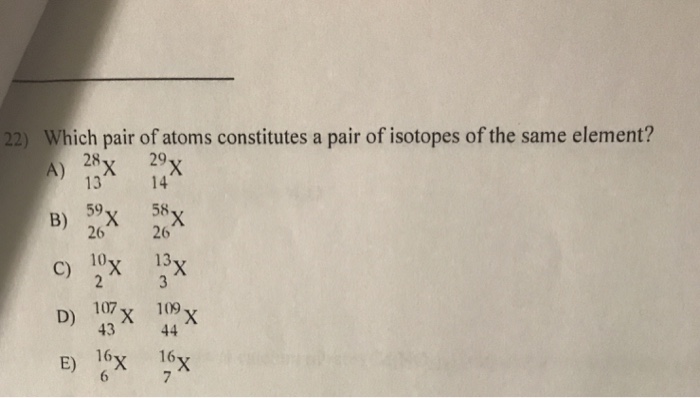
Pair Of Isotopes Example. Neutrons in uranium is 146. These both have the same mass number, which is 58, whereas the atomic number of nickel is 28, and the atomic number of iron is 26.
Solved Ch Pair Of Atoms Constitutes A Pair Of Isotopes Of... from www.chegg.com
For example, there are a lot of carbon atoms in the universe. Neutrons in uranium is 146. The difference between neutrons and protons in thorium and uranium is the same, so it is an example of isodiaphers.
It Means That The Isotopes Have The Same Number Of Electrons And Protons But A Different Number Of Neutrons.
Isotope → isotopes are atoms with the same number of protons, but differ in numbers of neutrons. For example, there are a lot of carbon atoms in the universe. Although some of them occur naturally, others are synthesized in the laboratory.
Hence, All Three Of Them Have The Same Atomic.
Isotopes are different forms of a single element. So let's do a few isotopes example problems where we have to write specific isotope notations and/or find the numbers of electrons, protons, and neutrons. Isotopes of carbon are the commonest examples.
Isotopes Are Different Forms Of A Single Element.
The difference between neutrons and protons in thorium and uranium is the same, so it is an example of isodiaphers. The difference between neutrons and protons in uranium. It means that the isotopes have same number of electrons and protons but different number of neutrons.
Oxygen Has Three Isotopes, Nickle Has Five Isotopes, Calcium Has 6 Isotopes, Palladium Has 6 Isotopes, Cadmium Has Nine Isotopes, Tin Has Eleven Isotopes.
These twins have the same temperament. Here, all three of them have same atomic number i.e. 1 but different mass numbers.
Correct Option Is D) Isotopes Are Elements With Same Atomic Number But Different Mass Number.
There are a few straggler atoms that don't have 6. Protons in uranium is 92. An isotope is a variation of an element that possesses the same atomic number but a different mass number.


Comments
Post a Comment